Picture credits
The drawings are our own. The photos are from Wikimedia Commons, under Creative Commons licences (Attribution, or Attribution-ShareAlike), CC0, or in the public domain.
Photos
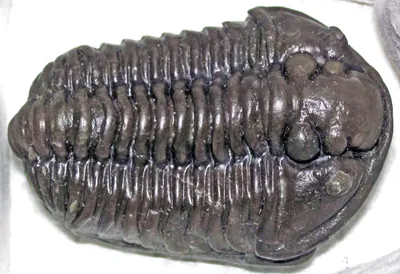 Calymene blumenbachii (fossil trilobite) (Much Wenlock Limestone, Middle Silurian; Wrens Nest, Dudley, England) 6.jpg
by James St. John, CC BY 2.0. Cropped and resized; no other changes.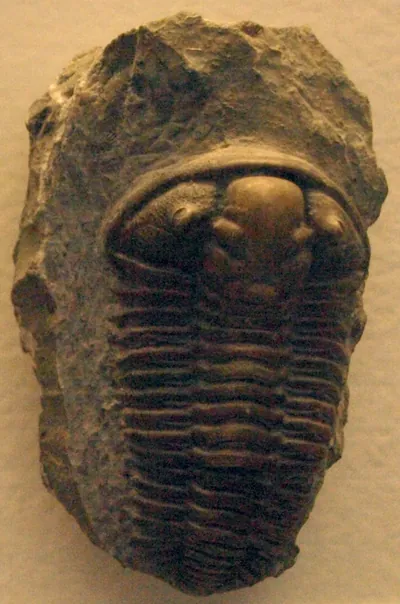 CalymeneBlumenbachii-NaturalHistoryMuseum-August23-08.jpg
by Captmondo, CC BY-SA 3.0. Cropped and resized; no other changes. Shared here under the same licence.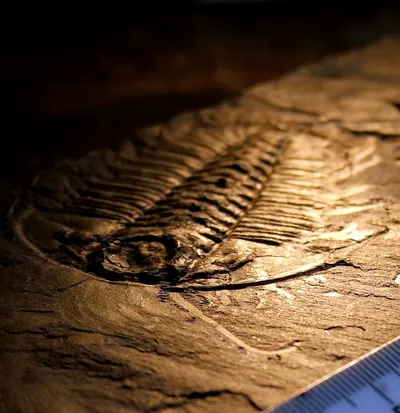 Olenoides serratus oblique with antennas.jpg
by Smith609 (Wikimedia Commons user), CC BY 2.5. Cropped and resized; no other changes.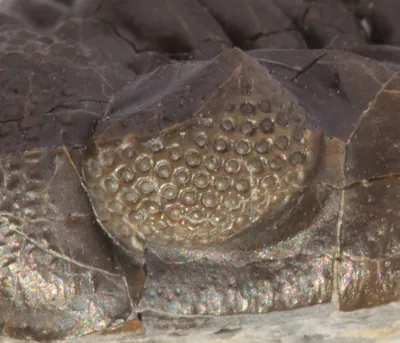 Phacops rana crassituberculata, eye.jpg
by Dwergenpaartje, CC BY-SA 3.0. Cropped and resized; no other changes. Shared here under the same licence.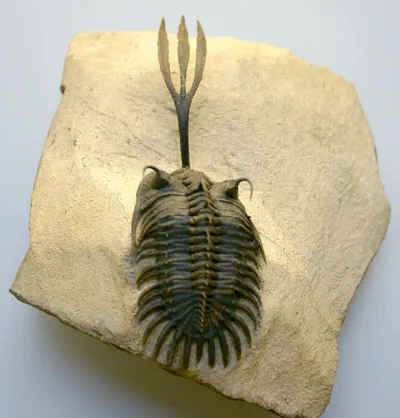 Trilobite Walliserops trifurcatus.jpg
by Kevin Walsh, CC BY 2.0. Cropped and resized; no other changes.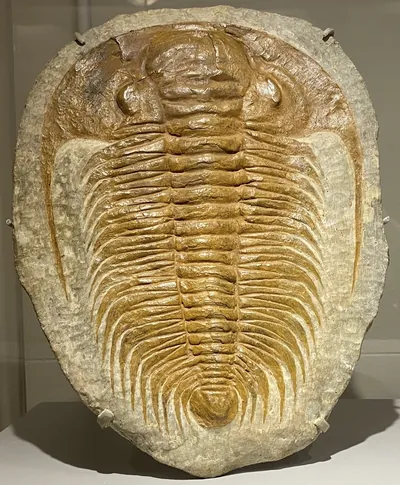
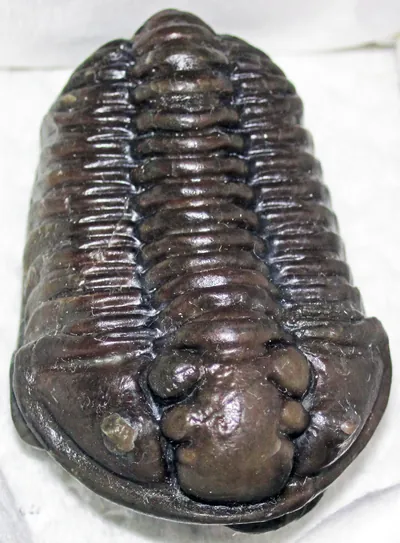 Calymene blumenbachii (fossil trilobite) (Much Wenlock Limestone, Middle Silurian; Wrens Nest, Dudley, England) 7.jpg
by James St. John, CC BY 2.0. Cropped and resized; no other changes.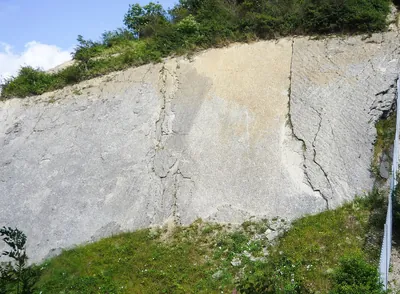 Wren's Nest National Nature Reserve - ripple beds.jpg
by DeFacto, CC BY-SA 4.0. Cropped and resized; no other changes. Shared here under the same licence.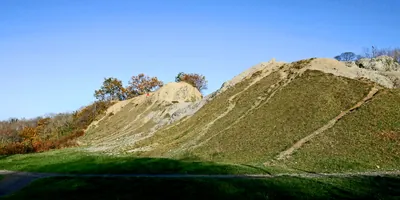 Limestone reef mounds on Wren's Nest Hill, Dudley - geograph.org.uk - 7346818.jpg
by Roger D Kidd, CC BY-SA 2.0. Cropped and resized; no other changes. Shared here under the same licence.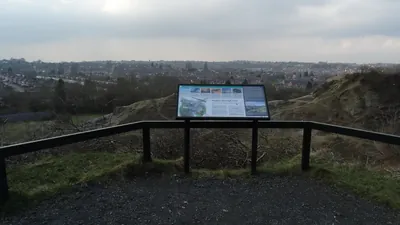 Geological Trail at Wren's Nest, Dudley - geograph.org.uk - 5279295.jpg
by Colin Park, CC BY-SA 2.0. Cropped and resized; no other changes. Shared here under the same licence.
Our own drawings
- A labelled top view of a trilobite. The rounded head, the cephalon, has a raised middle called the glabella, a fixed cheek beside it, two oval eyes, free cheeks on the outside of a dashed facial suture, and pointed back corners called genal spines. Below it the thorax is a stack of thirteen segments, each with a central axis and side lobes called pleurae. At the bottom is a fused, rounded tail called the pygidium.
Our own drawing - Two copies of the same trilobite outline. On the left, coloured bands divide it from head to tail into the head, the thorax and the tail. On the right, coloured bands divide it from side to side into a left pleura, a central axis and a right pleura, with a note that the British Geological Survey says the name refers to this side-to-side split.
Our own drawing - Three side views of a trilobite on the sea floor. First flat and walking, then bending in the middle, then curled into a tight ball with its soft underside hidden.
Our own drawing - A to-scale bar chart of trilobite lengths in centimetres. Acanthopleurella stipulae, 1.5 millimetres, is a barely visible sliver. Calymene, about 2 centimetres, is a short bar. Many trilobites, 3 to 6 centimetres, are a slightly longer bar. Paradoxides harlani, more than 45 centimetres; Paradoxides, up to 60 centimetres or more; and Isotelus rex, 72 centimetres, are long bars.
Our own drawing - A strip of six coloured boxes for the six geological periods: Cambrian, Ordovician, Silurian, Devonian, Carboniferous and Permian, from 538 million years ago to about 250 million years ago. Markers show the first trilobites about 520 million years ago, extinctions at the end of the Cambrian, an ice age 440 million years ago, a bounce back in the Silurian, the loss of reefs at the end of the Devonian when only the Proetida carried on, and the trilobites gone just before the Great Dying.
Our own drawing - Five simple drawings of trilobite eyes. An oval packed with many tiny round lenses, like a fly’s eye. Phacops, with fewer, bigger drop-shaped lenses. Erbenochile, a tall tower covered in lenses. Asaphus kowalewskii, a round eye on top of a long stalk. And a blind head with no eye at all.
Our own drawing - An end-on view of one trilobite body segment: a hard arched shield on top with a raised central axis, and below it on each side a leg with two branches. The lower branch is jointed and reaches down to the sea floor for walking. The upper branch sticks out sideways and carries a fringe of fine filaments, perhaps for breathing.
Our own drawing
The drawings are simplified teaching drawings made from the sourced figures on this site. The size chart is to scale; the others are not. Useless the eraser is the network’s own mascot. Fonts: Bricolage Grotesque, Newsreader and Kalam (SIL Open Font Licence), served from this site.