How trilobites lived
Hunters, scavengers, mud-grazers and swimmers.
How this site works. Every fact is in our own words and linked to its source, beside it. Where good sources disagree, we show each version in a “Sources differ” box.
What did they eat?
Some were predators and others scavengers, perhaps eating worm-like creatures and other small animals on the sea floor. NHM
In 2023 scientists described a Bohemolichas incola with its last meal still in its gut: tiny crustaceans called ostracods, bivalves and a starfish relative. NHM
Swimmers may have harvested plankton, many probably grazed mud, and some filtered food from the water. NHM
Some may even have farmed sulphur-eating bacteria, perhaps in their gills, as some clams do. NHM
What did they eat? Sources differ
- Britannica adds that some probably ate plankton. Britannica
- Dudley Council’s Wren’s Nest page says trilobites probably grazed on plants. Dudley Council, geology
Different trilobites lived very different lives, so several answers can be true at once.
Who ate them?
They were probably hunted by large Nautilus relatives, and later by jawed fishes. NHM
Anomalocaris was long suspected, but recent research suggests it may have preferred soft-bodied prey. NHM
Spines may have evolved to put off predators such as early jawed fishes. NHM
Where they lived
Some trilobites lived at particular depths, so they help geologists work out ancient environments. BGS
Trails such as Cruziana show that some trilobites moved about on the sea floor. BGS
Cyclopyge could see downwards as well as in other directions, so geologists think it swam or floated above the floor. BGS
Finding a mate
A Burgess Shale fossil of Olenoides serratus, described in 2022, shows two pairs of legs interpreted as claspers. NHM news
So males may have gripped females while mating, as horseshoe crabs do today. NHM news
The NHM’s Greg Edgecombe says it is the first time trilobite males and females were told apart by their legs rather than their shells or size. NHM news
Fossil trilobite eggs found in 2016 suggested a brood pouch. NHM news
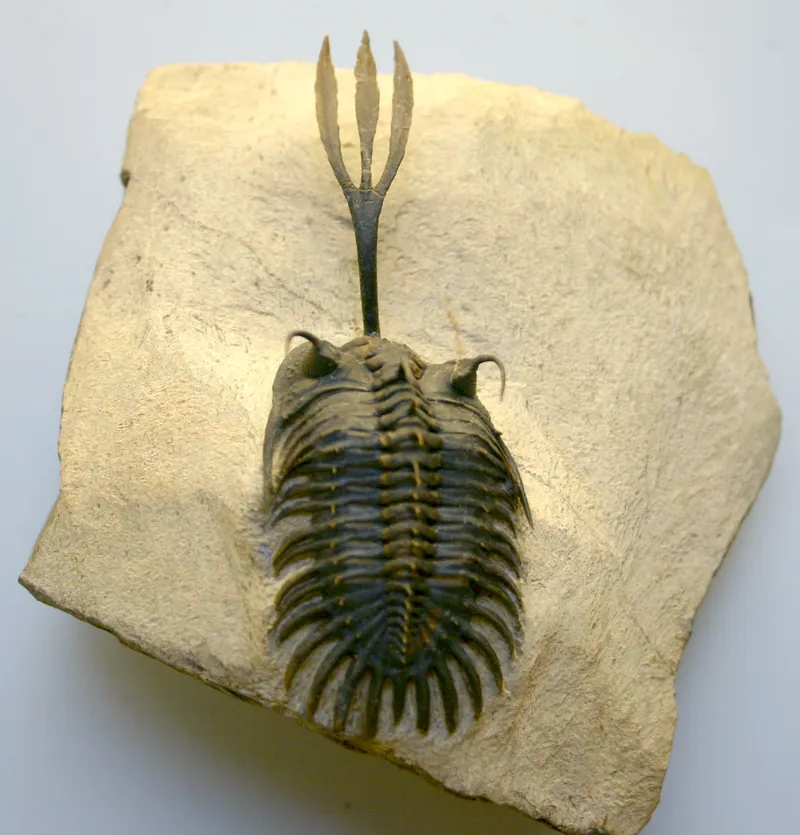
Walliserops had a large trident on its head, perhaps for contests over mates. NHM
How big?
The smallest known is Acanthopleurella stipulae, 1.5 mm long. NHM
That is narrower than a strand of spaghetti. NHM
A typical trilobite, Calymene, is about two centimetres long. NHM
Many trilobites were 3 to 6 cm long. BGS
The largest is Isotelus rex, 72 cm long and 40 cm wide (the NHM page spells it Isoteus). NHM
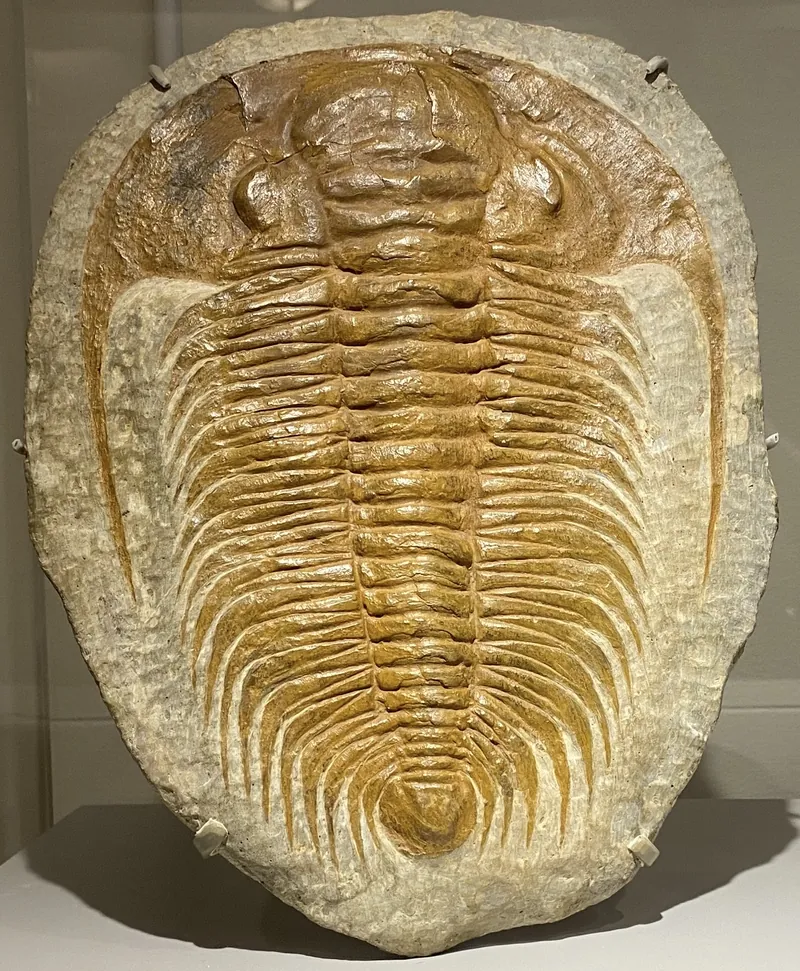
Paradoxides was a giant, up to 60 cm or more. BGS
Britannica says Paradoxides harlani, found near Boston, grew to more than 45 cm and may have weighed as much as 4.5 kg. Britannica
Tiny blind agnostids were only a few millimetres long. BGS
Some scientists have questioned whether agnostids are really trilobites at all. BGS
Next: deep time →