Crystal eyes
Trilobites saw the world through lenses of calcite, a mineral.
How this site works. Every fact is in our own words and linked to its source, beside it. Where good sources disagree, we show each version in a “Sources differ” box.
Trilobite eyes were made of calcite, a crystal: the NHM says no other animal is known to have had that before or since. NHM
Fortey says other arthropods have soft eyes, made of cuticle like the rest of the body. NHM
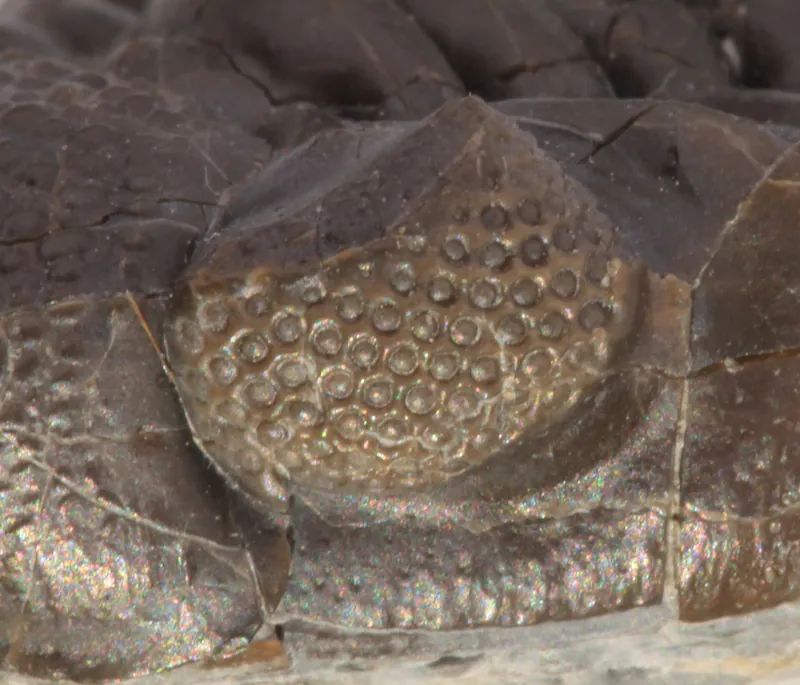
Most had compound eyes made of many separate lenses, though blind forms are known. BGS
Most were stacks of calcite prisms pointing in slightly different directions; more prisms probably meant better eyesight. NHM
Species had anything from one to several thousand lenses. NHM
Different eyes, different lives
Phacops had more complex lenses, and may have been able to see an object clearly and judge how far away it was. BGS
Phacops eyes had drop-shaped lenses rather than hexagonal ones. NHM
Some big, curved eyes gave a view forwards, backwards, sideways, up and even down. BGS
Some with giant bulging eyes were probably open-ocean swimmers watching for prey. NHM
Erbenochile had tall, tower-like eyes that could probably scan for prey at a distance. NHM
Asaphus kowalewskii had eyes on stalks. NHM
One species of Cyclopyge had eyes fused into one large ‘super eye’. NHM
Others had no eyes at all, and may have burrowed in mud or lived deep in dark water. NHM
Our view: a crystal eye is one of the strangest things in the fossil record. It is also why we can still look into a trilobite’s eye today.
Next: life and size →